The conversation people think they know
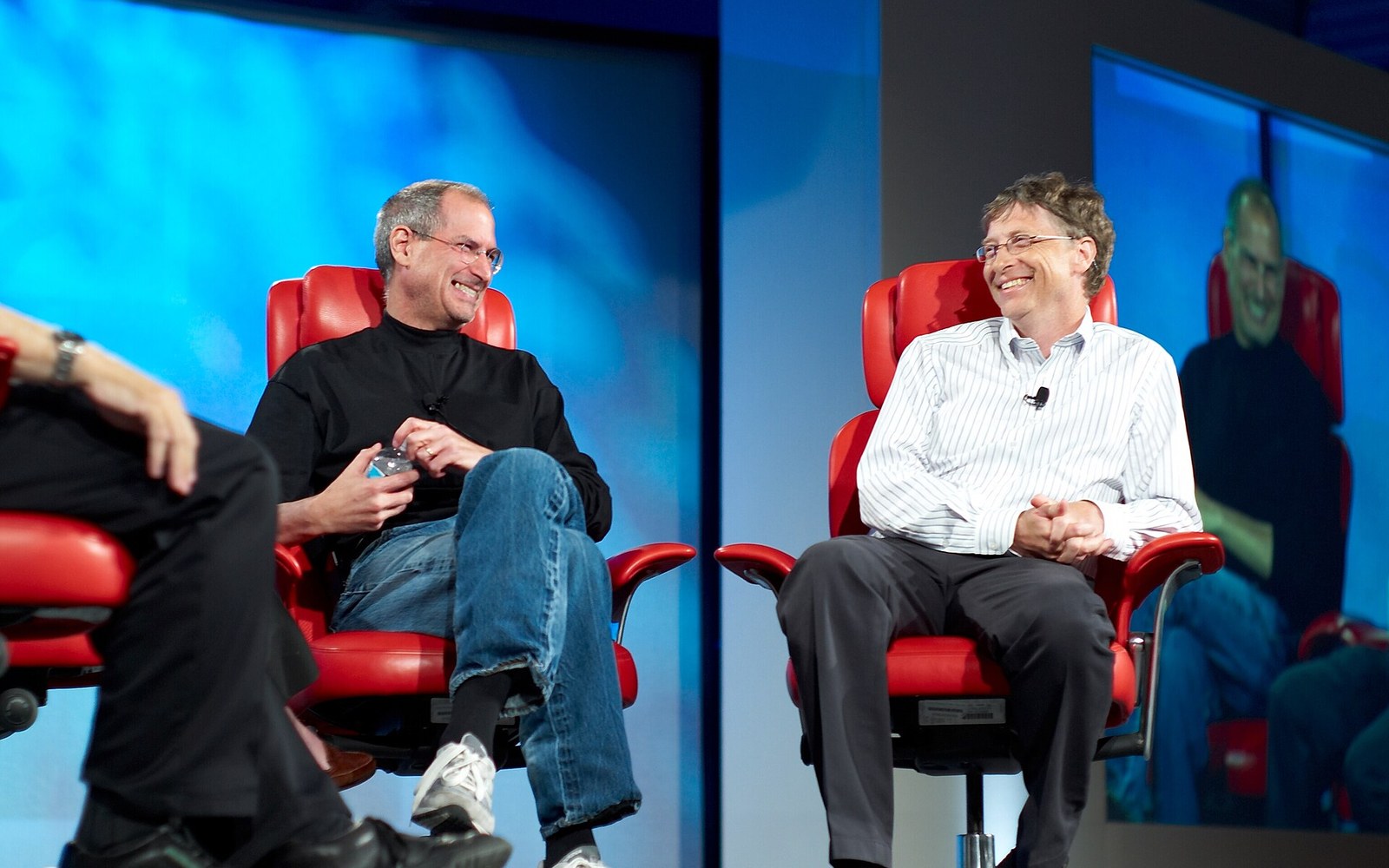
On May 30, 2007, Steve Jobs and Bill Gates sat together on stage at the D: All Things Digital conference in Carlsbad, California, for an unscripted hour-and-a-half interview conducted by Walt Mossberg and Kara Swisher. It was the first time the two men had appeared in conversation publicly since the personal-computer era had made them famous adversaries. The full video remains available through the D: All Things Digital archive at the Wall Street Journal ↗, which is where the circulating excerpts should be checked.
Most of what recirculates from that evening is a very short list: Jobs comparing their relationship to a Paul McCartney–John Lennon partnership, Gates offering careful praise for the iPod, and a sharp Jobs line about Microsoft’s taste. The full record is less tidy, and more revealing.

What the excerpts leave out
The McCartney-Lennon remark is routinely cited as a piece of Jobs magnanimity. In context, he was answering a direct question about what he and Gates had meant to each other, and he framed the analogy carefully — noting that he and Gates had each been better for existing alongside the other, and that both the Beatles analogy and the rivalry narrative were simplifications. The generosity reads differently when the question is restored.
The taste remark is the sharpest excerpt in circulation. Jobs, discussing Microsoft’s difficulty producing elegant software, said that Microsoft had never had the humanities in its DNA the way technology companies needed. He did not use the word "taste" in the passage most often quoted — the word was his in other contexts — but the D5 version was a more measured formulation about cultural DNA and breadth of vision. Removing the hedging produces a cleaner insult than Jobs actually delivered.
- McCartney–Lennon analogyreal, but Jobs framed it as a mutual simplification, not a compliment in isolation
- "Taste" remarkthe formulation circulating online differs from the D5 version; Jobs spoke of cultural DNA
- "PCs as trucks"Jobs said this at D8 in 2010; frequently misdated or decontextualised
- Gates on Vista eraacknowledged the wrong turn unprompted; rarely appears in excerpts
Gates, for his part, was direct in ways the excerpts rarely reproduce. He credited Apple’s retail strategy and the iPod ecosystem as genuine competitive advantages, and he acknowledged that Windows had taken a wrong turn in the middle of the decade — a period that produced Windows Vista — without being asked to do so. That admission is almost never in the circulating version.
Both men were also asked about the future of computing. Jobs described what would happen to the traditional personal computer as other devices became more capable, using the phrase that tablet and mobile critics would later recall: that PCs would become like trucks — still necessary, still well made, but no longer the vehicle most people drove. He said this at D8 in 2010, shortly after the iPad introduction in January 2010 had made the argument concrete. The full passage makes clear he was already thinking in those terms.
Short excerpts make both men more quotable and more combative than they were in the room.
Gates returned several times to the theme of software as the central challenge — not hardware elegance or industrial design — and the exchange that followed became a civil but substantive disagreement about where the work actually resided. Neither man yielded. That disagreement is essentially absent from the clips that travel.
The record against the legend
The D5 conversation is well documented because it was professionally recorded and the organisers authorised wide distribution. That makes it a cleaner case than most Jobs quotation questions, where the original recording either does not exist or has been paraphrased through several hands. Here the transcript can be compared directly to what circulates.
What the comparison shows is the usual compression problem. Short excerpts make both men more quotable and more combative than they were in the room. The warm passages — Jobs saying that Apple and Microsoft had been intertwined throughout their histories; Gates expressing what sounded like genuine admiration for the iPhone, which Jobs had announced at Macworld nearly five months earlier — land differently when the surrounding hour is audible.
The two men never shared a stage again. Jobs died in October 2011.
- January 9, 2007iPhone announced at Macworld, San Francisco
- May 30, 2007D5 conversation, Carlsbad, California
- October 5, 2011Jobs died