Cast Out, Then Building
When Apple’s board forced Steve Jobs out in September 1985, the public story became one of exile and return. The decade between that departure and the NeXT acquisition in December 1996 is usually framed as a detour — a proud, expensive side-road back to the main event. The hardware record, and one specific machine in a laboratory in Geneva, suggests a different reading.
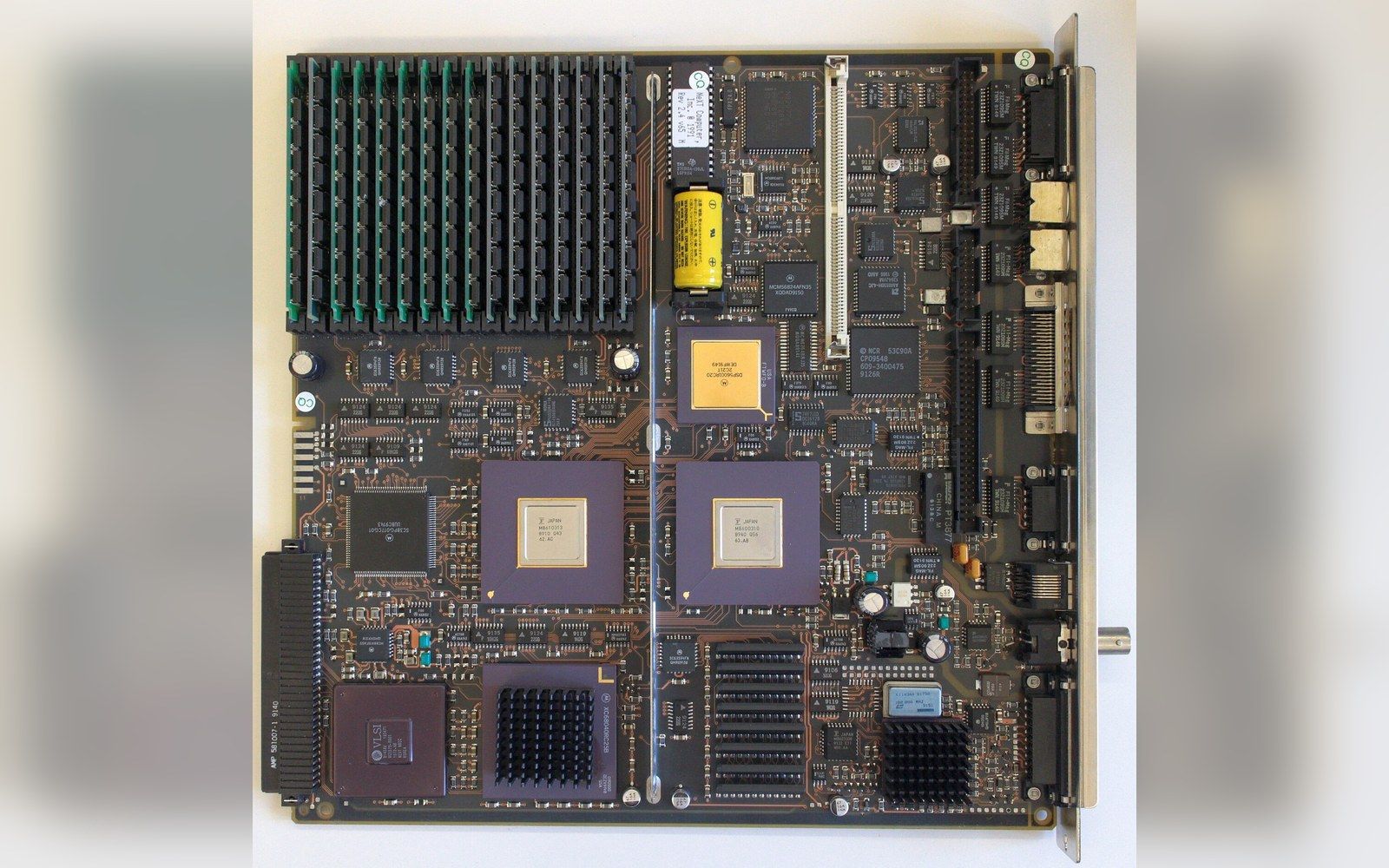
NeXT Inc. was incorporated in California in 1985 with Jobs as chairman. The company’s first product, the NeXTcube, was introduced in 1988 and began shipping in 1989 to universities and research institutions at a price of about $6,500 — that kept it off consumer desks but put it precisely where software was being invented. The cube was a magnesium-alloy enclosure, roughly a foot on each side, housing a Motorola 68030 processor and, in later configurations, a dedicated digital signal processor. Its industrial design was the work of Jobs’s team before Jony Ive entered the picture, and it bore the unmistakable Jobsian conviction that a computer’s physical form was itself an argument about what computing could be.
What justified the hardware’s price, and ultimately its place in history, was NeXTSTEP — the object-oriented operating system that ran on it. NeXTSTEP was built on a Mach kernel with a BSD Unix layer and used Objective-C as its primary development language. For a programmer in 1989 or 1990, writing software on NeXTSTEP was qualitatively different from writing it on anything else available: display PostScript, a sophisticated window server, and a suite of framework classes meant that complex applications could be assembled in a fraction of the time they would have taken elsewhere. That is not retrospective praise. It is what Tim Berners-Lee documented in his own account of the work he did at CERN.
The Machine in Geneva
In 1989, Berners-Lee, then a software engineer at CERN, the European particle physics laboratory near Geneva, submitted a proposal for a distributed information system he called "Information Management: A Proposal." His supervisor, Mike Sendall, wrote "vague but exciting" on the cover page — a judgment that has since achieved its own footnote status. Berners-Lee needed a platform on which to build the thing. He chose a NeXTcube.
By 1990, Berners-Lee had written the first web server, called httpd, and the first web browser and editor, called WorldWideWeb, both running on NeXTSTEP ↗. The choice was not arbitrary. NeXTSTEP’s Interface Builder tool, which let developers construct graphical interfaces by dragging components rather than writing layout code by hand, allowed Berners-Lee to build a functioning browser with editing capability faster than any other platform of the era would have permitted. The framework’s networking classes handled the lower-level communication work cleanly. The machine’s Unix underpinnings meant the server software could be ported to other systems once the concept was proven.
- September 1985Jobs forced out of Apple; NeXT Inc. incorporated
- 1988NeXTcube introduced at a public event; price approximately $6,500
- 1989Berners-Lee submits "Information Management: A Proposal" at CERN
- 1990First web server (httpd) and browser (WorldWideWeb) written on a NeXTcube running NeXTSTEP
- 1993NeXT exits hardware; pivots to NeXTSTEP as software product
- December 1996Apple acquires NeXT for approximately $429 million
- 2001Mac OS X ships, built on NeXTSTEP foundations
CERN marked the NeXTcube used in that work as "This machine is a server. DO NOT POWER IT DOWN!!" ↗ — a handwritten note that became one of the more celebrated artifacts in computing history. The machine itself is held in CERN’s collection. The web that three billion people subsequently used was first assembled on a product that Steve Jobs’s company made and that Jobs’s operating system made tractable.
What Jobs Said, and When
Jobs was not a man who undersold his own products. His keynotes and interviews from the NeXT years contain sustained arguments for NeXTSTEP’s developer advantages — the speed of assembly, the reusability of objects, the elegance of Objective-C. At the 1988 NeXT introduction event, he described the machine’s software environment in terms he would use again and again: the idea that objects were like Lego bricks, reusable components that snapped together to produce something larger. That construction metaphor was consistent across the NeXT decade.
What Jobs was slower to articulate, in the public record, was the specific connection between NeXTSTEP and the web. In the 1995 Computerworld Smithsonian Award oral history ↗, conducted by Daniel Morrow, Jobs discussed his sense of what computers would become and spoke about the role of networks, but he did not name Berners-Lee or describe CERN’s use of the cube as a validation of the platform. By 1995, NeXT had already abandoned hardware manufacturing — the company stopped selling computers in 1993 and pivoted to selling NeXTSTEP as a software product for Intel and other architectures — and Jobs’s public emphasis had shifted accordingly.
When Apple’s board forced Steve Jobs out in September 1985, the public story became one of exile and return.
The closest Jobs came to framing the NeXT decade as consequential in its own right, rather than as prologue to the Apple return, appears in Walter Isaacson’s 2011 biography. Isaacson records Jobs saying that NeXT was where he learned to build a real company with real culture, and that it taught him things he could not have learned if he had stayed at Apple. Whether those exact words were spoken in those exact terms is the standard caveat that applies to all quotation in Isaacson’s book — a secondary source compiled from interviews, not a verbatim transcript — but the substance is consistent with what Jobs said on the record in multiple interviews: that the NeXT period was not wasted time.
The Hinge of the Career
The NeXT acquisition brought more than Jobs back to Apple. It brought NeXTSTEP, which became the foundation of Mac OS X, released in 2001, and through Mac OS X the basis of iOS, the operating system that ran the iPhone from 2007 onward. The object-oriented frameworks Berners-Lee used to build the web’s first browser — AppKit, Foundation, Interface Builder — are recognizable ancestors of the frameworks Apple’s developers used to build the App Store’s million applications two decades later. The thread is direct and documented.
Jobs’s reputation rests, in the popular account, on the Macintosh, the iMac, the iPod, and the iPhone. That account is not wrong. But it elides the decade in which the technical substrate for three of those four products was actually built, and in which the operating system that made the World Wide Web buildable was shipped from a small company in Redwood City. The NeXTcube sitting in a CERN laboratory with a handwritten note taped to it is a primary source that no biography of Jobs has yet given adequate weight. The machine was not a footnote. It was, in any honest accounting, a hinge.
- The specific NeXTcube Berners-Lee used survives in CERN’s collection
- A handwritten note reading "This machine is a server. DO NOT POWER IT DOWN!!" was attached to it during active use
- It is one of the few computing artifacts whose precise provenance — machine, user, software, output — is unambiguously documented
Quotation record
- Jobs’s 1988 NeXT introduction: public on-stage description of NeXTSTEP’s object-oriented advantages (primary source; on record)
- 1995 Smithsonian oral history: Jobs on networks and computing’s future; no specific mention of Berners-Lee or CERN
- Isaacson biography (2011): Jobs on NeXT as formative; secondary source, not verbatim transcript